Is IEMT scientifically studied?
In March 2026 Maastricht University compared IEMT with EMDR in an exploratory study. Both showed a comparable drop in emotional charge, holding a week later. A first, non-clinical study — not hard proof, but a serious first signal.
At a glance
- Randomised laboratory study with 33 participants from the general population. Everyone received IEMT, EMDR and a control condition.
- After a single 20-minute session, the emotional charge of a negative memory dropped significantly more with both IEMT and EMDR than with the control condition.
- The effect held at a measurement one week later.
- IEMT and EMDR did not differ statistically in effect.
- 60.6% of participants preferred IEMT under blinded conditions.
- Participants in the EMDR condition more frequently reported headache, tension and tired eyes.
- Participants with IEMT reported more "insight, depth and synthesis" — without needing to share the content of the memory.
What this means for employers
For HR departments, occupational health professionals and managers who assess coaching provision or refer employees, these are the relevant points.
- Time investment. The effect was measured after a single 20-minute session. In practice, a full IEMT programme runs four to six sessions — shorter than the majority of psychosocial interventions.
- Fewer side effects. No headaches, fewer tired eyes. For employees returning to work the same afternoon, that is practically relevant.
- Content stays private. IEMT does not ask employees to share the content of a memory. That lowers the threshold for those who are reluctant to share personal details with an external coach.
- Effect comparable to EMDR. EMDR is recognised by the clinical standard as a treatment method. This study shows that IEMT performs comparably on the measured outcome.
- Mind the scope. This is not clinical research into PTSD treatment. That belongs with an occupational physician and insured care. For wellbeing, return-to-work support and prevention, this is relevant.
What this means for you
For anyone considering working with a coach or practitioner on a pattern, these are the points that stand out.
- You do not have to share everything. With IEMT, the memory is not the starting point of the protocol; the work starts with an emotion or a statement about yourself, and you do not need to explain the content. In the study, participants worked on a self-chosen negative memory, and not having to share that content was, for many, a key reason for their preference.
- Fewer physical side effects. Participants reported headaches and tired eyes more frequently with EMDR. Less so with IEMT.
- More "depth and synthesis". In participants' own words: IEMT felt quieter and gentler, and gave more insight into how things connect.
- Effect measurable in the short term. After a single 20-minute session, emotional charge was measurably lower — and still lower a week later.
- No obligation to talk. For those who have already told their story enough times — to a partner, friends or previous practitioners — this can be the difference between staying stuck and letting something shift.
Key findings in detail
Study design
Thirty-three participants from the general population received all three conditions in randomised order: IEMT, EMDR and a control condition (sitting quietly). Each participant chose three self-selected negative memories; which memory was paired with which condition was randomised and blinded to the participant. The primary outcome was the SUD score (Subjective Units of Distress), an 11-point scale for perceived emotional charge. Measurements: before, immediately after and one week later.
Drop in emotional charge
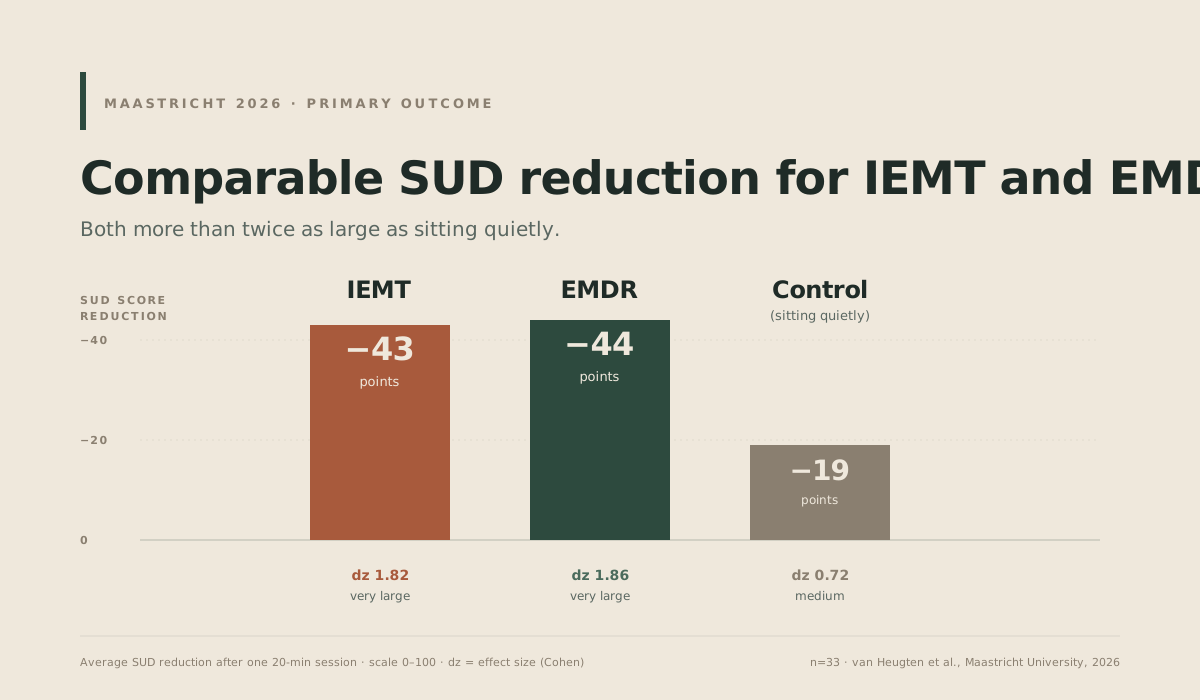
After the session, the SUD score dropped by an average of 44 points with EMDR (on a scale of 0–100) and 43 points with IEMT. Those are effect sizes (Cohen's dz 1.86 and 1.82 respectively) that the scientific literature classifies as "very large". The control condition also showed a drop, but a clearly smaller one (19 points, dz = 0.72). At the one-week follow-up this difference remained.
Participant preference — blinded
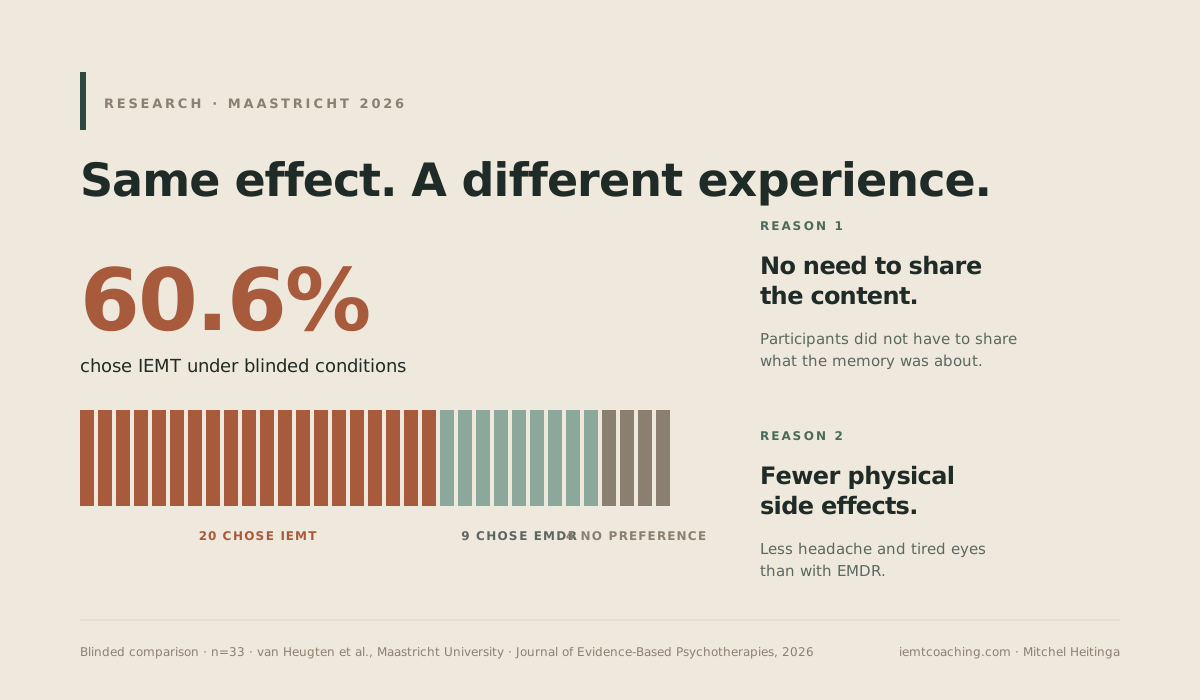
Because each participant underwent all three conditions without knowing which was which, they could express a preference at the end without bias from name recognition. Result:
- 20 participants (60.6%) preferred IEMT
- 9 participants (27.3%) preferred EMDR
- 4 participants (12.1%) had no preference
Why participants preferred IEMT
The reasons participants themselves gave for their IEMT preference (mentioned multiple times):
- Quieter, gentler, more emotionally grounded perspective (×10)
- More insight, depth and synthesis through its encompassing character (×10)
- Eye movements felt more comfortable (×5)
- No need to talk (×4)
- More intense, but felt more effective (×4)
- No headache, no tired eyes (×4)
Stress and depression scores
Also notable: on the DASS-21-R (a standardised questionnaire), participants scored on average lower on stress (2.1 points) and depressive symptoms (3.0 points) one week after the experiment. For anxiety there was no significant effect. The authors are cautious here: the sample was non-clinical and already scored within the "normal" range.
What this study does not establish
The authors name the limitations explicitly and clearly. It is worth naming them here too, because they determine what you can and cannot conclude from this paper.
- The sample was small (N = 33) and non-clinical. This is exploratory work, not large-scale clinical evidence.
- Each condition lasted only 20 minutes. Practitioners could not apply the full protocol (which takes longer); the study therefore compares eye movement techniques, not the full therapy forms.
- There was no active working-memory control task (such as Tetris). That means it cannot be firmly ruled out that the effect comes from working-memory load in a broad sense, rather than specifically from eye movements.
- Generalisability to clinical groups (PTSD, anxiety disorders) is unclear on the basis of this study.
- The underlying neurological mechanisms were not measured in this study. The authors recommend follow-up EEG and MRI research.
In short: this study shows that the eye movement technique in IEMT is as effective as that of EMDR in an experimental setting, and is experienced as more pleasant by participants. It does not yet establish that IEMT is proven effective for PTSD, anxiety disorders or other clinical diagnoses. That requires larger clinical studies — which are currently in preparation.
Transparency about my role
I work as an IEMT trainer and coach. That means I have a commercial interest in a positive reception of IEMT. It is only fair to name that. This study was conducted by an independent university consortium (Maastricht University, JeBeNTR, IEMT-training Ruurlo); I had no role in it — not in the design, the analysis or the reporting. I share this paper because it is the first direct comparison and because it is relevant to people considering my work.
The authors themselves note in their paper that IEMT in its current form contains elements of pseudoscience — which is precisely why they conducted this first rigorous comparison. That openness is what makes the study credible.
Original paper and further reading
The full peer-reviewed paper is available via the publisher:
DOI reference: 10.24193/jebp.2026.1.1
For further questions about how IEMT is used in a coaching programme: read about my approach or book a discovery call.